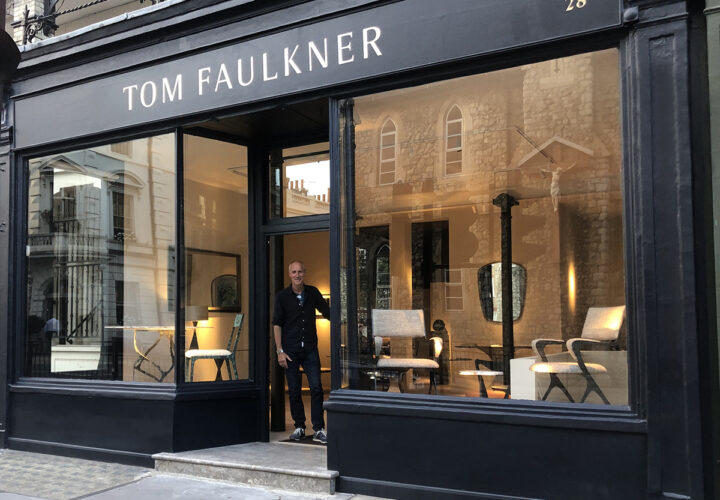

South America is home to a fascinating and diverse architectural legacy. It’s a tapestry of historical styles cast in a spectrum of rich materials which continues to influence global tastes. Tom recently travelled through Argentina to get a sense of both the natural majesty of Patagonia and the cultural abundance of Buenos Aires. He was struck by the stoic beauty of Brutalist architecture and the ingenuity of modern design in its many forms. To dig a little deeper into his findings, we’ve drawn together a collection of modern South American architects whose work is emblematic of the continent’s vivid creative history. Read on for an introduction to our top ten names of note…
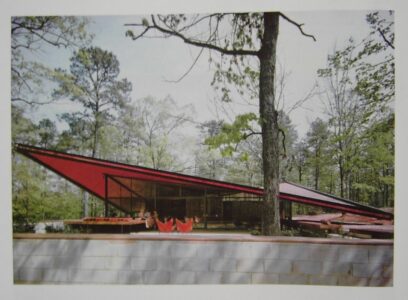
Raleigh House (1954) by Eduardo Catalano; photographed by Ernest Delaville
Argentine architect Eduardo Catalano’s influence continues to be felt well beyond his home country, rippling northward in the form of sleek modernist structures. He initially set off for the US to study architecture at both the University of Pennsylvania and Harvard. He ended up designing many buildings for a slew of American universities. It wasn’t until he designed Raleigh House, however, that he really started to catch the eye of the architectural community. The project earned him rare praise from none other than Frank Lloyd Wright, who admired his imaginative treatment of the roof. Catalano articulates the great, slanting expanse in modern materials with a decidedly crisp look. His introduction of the red-hot hue warms up the overall effect while giving the house the resoundingly unique character for which its remembered.
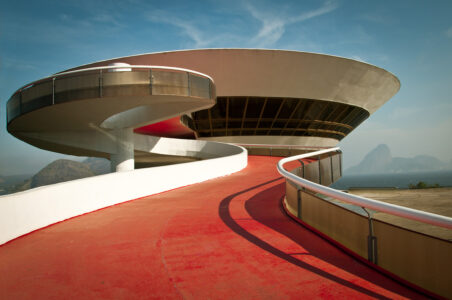
Niterói Contemporary Art Museum (1996) by Oscar Niemeyer; photographed by Catalina Pérez López
When speaking of South American architecture, Oscar Niemeyer’s name tends to be among the first mentioned. He was the Brazilian architect behind some of the country’s most iconic structures. Often referred to as a “sculptor of monuments”, his work peppers city parks and punctuates coastal views best known to those beyond the continent. His crowning achievement, however, comes in the form of an entire city. Brasília was conceived as a brand-new capital for the modern era. In the mid-1950s Niemeyer was tapped to help plan it in a practical sense as well as sculpt the forms which would represent this optimistic future. He articulated it in flowing, sinuous curves formed of reinforced concrete and finished in a crisp white – set blazing by the tropical sun. Where there was once a baren inland expanse now stood a gleaming capital city with both eyes on the future. In 1987 Niemeyer’s work earned Brasília UNESCO World Heritage Site status, making him the first architect to be honoured in such a way during his lifetime. His bold vision and exploratory spirit helped to redefine the possibilities of unassuming materials like concrete, paving the way for the many minds who would take up the mantle of modernism in his wake.

National Library of Argentina (1992) by Alicia Cazzaniga, Clorindo Testa, and Francisco Bullrich; photographed by Tom
Argentine architect Alicia Cazzaniga is not so widely known as many of her counterparts – perhaps due in part to her regrettably short life, which ended at just 39 years old. She did, however, make a notable contribution to the country’s architectural tradition from that early point in what was set to become a tremendous creative career. While Tom was exploring Buenos Aires, he was struck by the city’s National Library, which Cazzaniga designed alongside Clorindo Testa and Francisco Bullrich. The library was built on the former site of Unzué Palace, the official residence where President Juan Perón and Evita lived. After the residence’s politically motivated demolition in 1958, talks began around a new library. The construction process would stretch over more than thirty years, amidst ever-changing political tides. Throughout the design process, Cazzaniga drew upon Rationalist principles, co-opted alongside elements of the Bauhaus sensibility. She worked them into a Brutalist style, showcasing humble materials in their raw form and laying bare the structural elements of architecture which make buildings work. In doing so, she helped to develop the style which would become one of the Argentina’s key architectural legacies.

Iglesia Atlántida (1960) by Eladio Dieste; photographed by Nicolas Barriola
Eladio Dieste was technically an engineer, though his contributions to the Uruguayan architectural landscape are immense. He developed various structural innovations which redefined formal possibilities, allowing simple materials to take on strikingly slim proportions in captivating curves. He’s best known for his use of good, old-fashioned brick and tile, which he applied to humble structures like grain silos with the same care and attention as to his celebrated churches. His body of work, though diverse, is united by a sense of elegance which brings nobility to even the most basic of built necessities.

Ciudad Universitaria de Caracas (1950s) by Carlos Raúl Villanueva
Carlos Raúl Villanueva is widely heralded as the father of Venezuelan modern architecture. His work on projects like Caracas’s Ciudad Universitaria established him as a fresh force within the mid-century architectural field. He worked in great, sweeping forms which created dynamic environments, often conceived in collaboration with artists. The interior of the university’s auditorium is a great example, with its acoustic “clouds” by American sculptor Alexander Calder. The result is built environments designed to be experienced in a complete sense, playing with space and light to inform the way in which we move through the world.

Opéra Bastille (1989) by Carlos Ott; photographed by Arthur Weidmann
Carlos Ott is, in his words, “one of those lucky fellows who knew what he wanted to do in life, at the age of five.” From his early days lending a hand at his father’s architectural practice in Uruguay, he was focused on designing buildings with true impact. He set his sights high – as in Burj Al Arab high. Unfortunately, bungled contact details led to confusion with his submission for the project, though another firm did proceed with an adaptation of his plans. Ott’s moment in the sun eventually came along when he won the bid for Paris’s Opéra Bastille. His entrancing glass and metal design has become his calling card, of sorts, establishing him as a key figure in modern architecture.

SESC Pompéia (1986) by Lina Bo Bardi; photographed by Paulisson Miura
Lina Bo Bardi was an Italian-born Brazilian architect who took an emphatically modernist approach to her work. Much of it incorporates artful splashes of playfulness, which bring a freshness and approachability to much of her Brutalist architecture. Bo Bardi’s SESC Pompéia beautifully exemplifies her ingenuity as a designer, with a river running through it, amorphous windows shuttered in red, and a labyrinthine system of suspended walkways. There’s joie de vivre in every step through these spaces, which emanates out into São Paulo’s lively atmosphere.

Sexto Panteón (1949) by Ítala Fulvia Villa; photographed by Tom
Ítala Fulvia Villa was an Argentine architect best remembered for her Sexto Panteón, often referred to as the Brutalist Necropolis of Buenos Aires. It’s a curious place, which Tom visited on his recent trip around the country. It’s quite singular in its application of the Brutalist style within a funerary context, remaining the first and largest complex of its kind. There’s a sense of sombre solidity to the place, punctuated by blocky forms cast in concrete and left to evolve with the elements. Villa, herself was quite the trailblazer. She was among Argentina’s first female architects, initially finding recognition in her work as an urban planner alongside Le Corbusier. It seems fitting she should be the one to reimagine this city of the dead in new and unexpected terms.
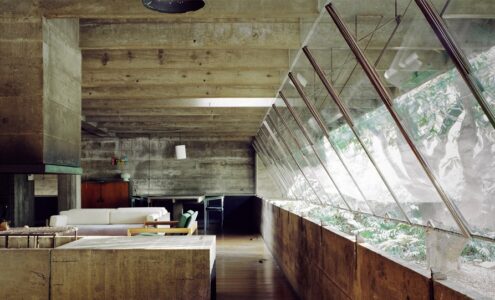
Casa Butantã (1966) by Paulo Mendes da Rocha
Paulo Mendes da Rocha was a Brazilian architect whose work exists almost exclusively in his home country. His oeuvre has become synonymous with Brazilian Brutalism, many of his designs taking form as great concrete fortresses couched amidst tropical foliage. Much of his work, however, is less closed-off and contained than first glance may suggest. The twin houses he designed for himself and his sister are excellent examples. Each one takes on a very open plan, with bedrooms located centrally and top-lit to maximise flow of movement, ventilation, and views around the peripheries of the houses. The result is a pair of homes which feel connected with the world beyond, intrinsic to the fabric of São Paulo’s Butantã neighbourhood.

Torres del Parque, Torre B (1970) by Rogelio Salmona; photographed by Felipe Restrepo Acosta
The French-born Colombian architect Rogelio Salmona has become something of a figurehead for modern Colombian design. He was captivated by the shapes of nature, working radial geometry, spirals, and flowing curves into his work at just about every opportunity. He cut his teeth alongside Le Corbusier, assisting with major projects like the Pilot Plan for Bogotá as well as Chandigarh. He then travelled to Spain, encountering the Islamic architecture which would bear a pronounced influence on his work back at home. He was inspired by the use of brick he saw in Grenada, incorporating the material into his own designs which, in turn, took on the salmon tone for which he’s known. His work became a tapestry of sights seen and ideas collected, flowing together to form the face of modern Colombian architecture.
Text by Annabel Colterjohn